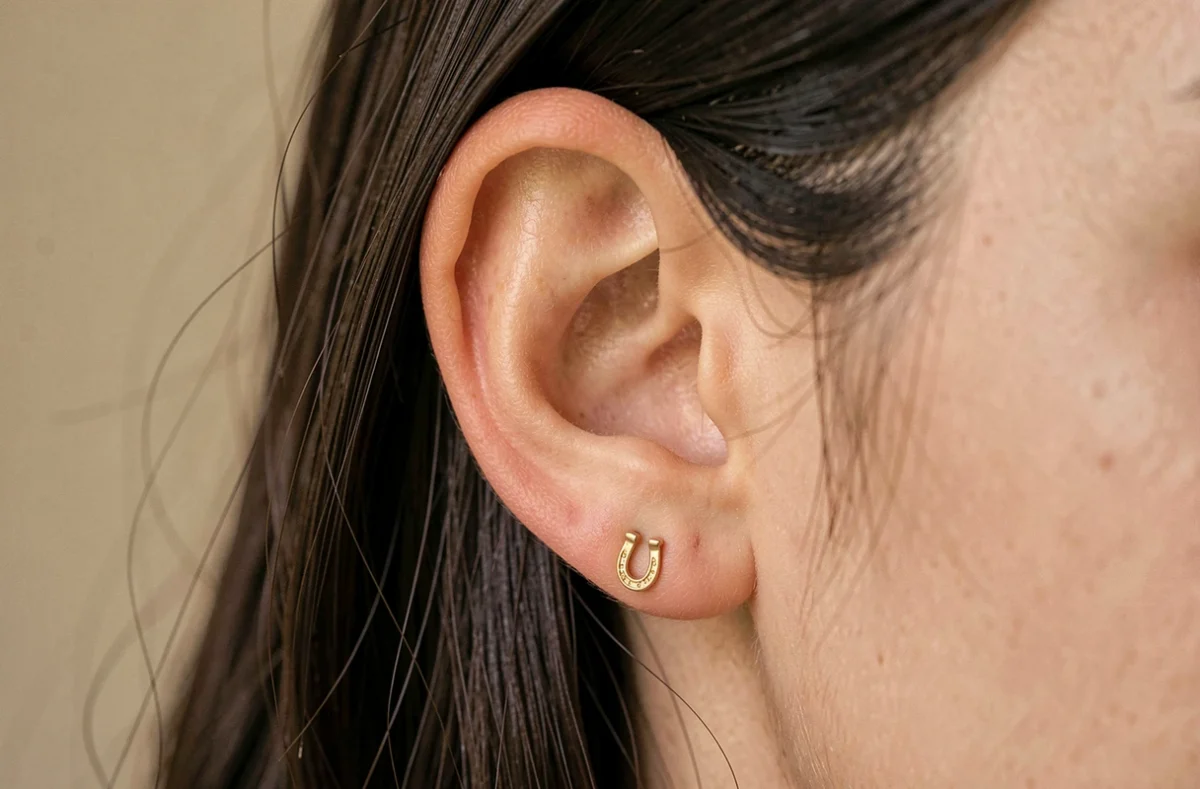
The horseshoe, or circular barbell, is a piercing jewelry style whose open shape creates a distinctive look on the tragus. But there are several factors to consider, including the inner diameter, bar thickness, and material. Comparing these variables helps you distinguish a suitable piece from one that could cause problems in the first few weeks.
Horseshoe, labret, and closed ring for the tragus: comparison table
The three most common jewelry styles for the tragus do not perform equally across all criteria. Here is a summary of the differences based on information available from professional piercers.
| Criteria | Horseshoe (circular barbell) | Labret (straight bar, flat back) | Closed ring (segment ring) |
|---|---|---|---|
| Movement in the piercing channel | Moderate to high (open shape, two exposed balls) | Low (flat back sits against the skin) | Moderate (can rotate) |
| Risk of snagging | Moderate (balls protrude from the tragus) | Low | Moderate |
| Comfort with in-ear headphones | Limited (the balls get in the way when inserting them) | Good (flat profile on the ear canal side) | Varies depending on the diameter |
| Ease of cleaning | Good (both sides are easy to access) | Moderate (the flat back can sometimes be hard to reach) | Good |
| Suitable as initial jewelry (during healing) | Not recommended by most piercers | Recommended | Not recommended |
The labret offers the best comfort and stability during healing. The horseshoe, on the other hand, comes into its own once the piercing has healed, when the jewelry’s movement is less likely to irritate the channel.
Wearing a horseshoe tragus piercing too early in the healing process can cause repeated micro-movements that slow healing. A professional piercer will generally recommend waiting several months before switching to this style.

Horseshoe tragus piercing dimensions: thickness and inner diameter
The standard size for a tragus piercing is 1.2 mm thick, with a 7 mm bar length. These measurements suit most anatomies, but not all.
For a horseshoe, the relevant measurement is not the bar length (which applies to labrets) but the ring’s inner diameter. A diameter that is too small can compress the tragus, especially if it swells. A diameter that is too large increases the risk of snagging and allows the jewelry to rotate more.
Bar thickness: why 1.2 mm is the standard
The tragus is an area of relatively thin cartilage. Thicker gauges (1.6 mm) are possible but less common for this area. A thickness of 1.2 mm remains the standard recommended by most piercers for the tragus, as it limits pressure on the cartilage while ensuring the jewelry is sturdy.
Inner diameter: 6 to 8 mm, depending on your anatomy
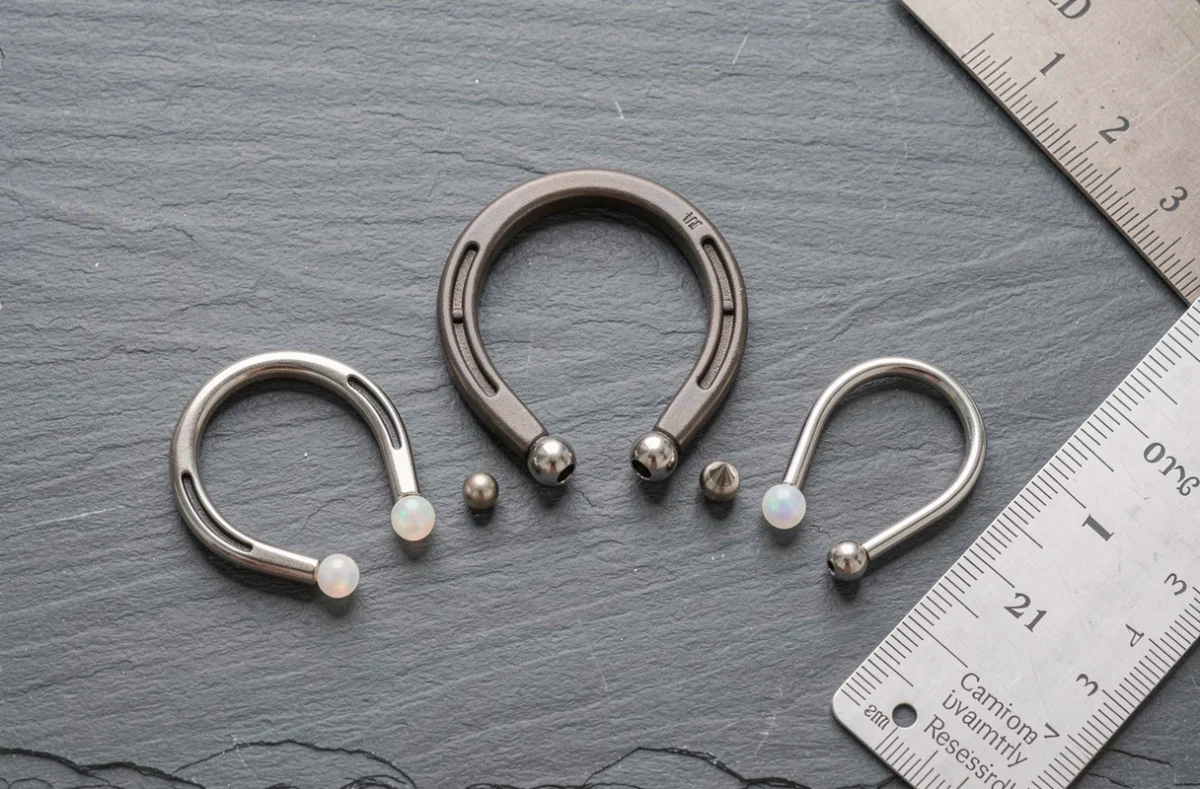
Horseshoe tragus jewelry most commonly comes in inner diameters of 6 mm or 8 mm. The right choice depends on the size of your tragus and the look you want:
- A 6 mm diameter gives a snugger, more discreet fit, but may compress the skin if your tragus is fleshy or prone to swelling
- An 8 mm diameter provides more room and reduces pressure, but the balls protrude further and may get in the way with some headphones
- Having a professional piercer check the fit is the most reliable way to confirm which diameter suits your anatomy
Horseshoe tragus piercing materials: titanium, steel, and coatings
The jewelry material directly affects skin tolerance, especially in an area of cartilage where healing takes longer than it does in an earlobe.
Implant-grade titanium (ASTM F-136) is the material of choice for tragus piercings. It does not release nickel, is lightweight, and causes very few allergic reactions. Surgical steel (316L) is a widely used alternative, but its alloy contains nickel.
Nickel release: what REACH actually regulates
The European REACH regulation sets a maximum limit for nickel release, not nickel-free composition. Compliance is measured using the EN 12472 (wear simulation) and EN 1811 (release measurement) methods. So a piece of jewelry labeled “nickel-free” in a store may still contain nickel, as long as the amount released on contact with the skin remains below the regulatory limit.
This distinction is even more important for colored horseshoe jewelry (anodized or PVD-coated). Coatings wear down over time, and compliance with the release limit must account for simulated wear before testing. A piece that complies when new may no longer do so after a few months of daily wear if its coating deteriorates.
- Choose ASTM F-136 titanium, especially for a new piercing or sensitive skin
- Check that the compliance claim refers to nickel release (REACH), not just the material’s composition
- For colored horseshoe jewelry, ask the seller whether the release test includes prior wear simulation
When to switch to a horseshoe after a tragus piercing
A horseshoe is generally not used as initial jewelry. Tragus cartilage takes several months to heal, and during this time a labret with a flat back offers greater stability. Jewelry that moves in an unhealed channel can cause chronic irritation and even piercing bumps.
Ideally, switch to a horseshoe only after your piercer has approved the change, once the channel is stable and the skin is no longer tender to the touch. Changing jewelry too early is the most common cause of complications with a tragus piercing.
A properly sized horseshoe made from implant-grade titanium and fitted at the right time is a comfortable, distinctive piece of jewelry for the tragus. The one thing online guides cannot replace is having a professional measure your anatomy in person.