Natural stone does not tolerate improvisation or randomly used abrasive products. A simple household cleaner can alter the surface, cause stains, or accelerate wear. Yet, most stone barbecues accumulate greasy residues and soot deposits that embed over time.
Some joints degrade under the effects of heat and weather, making the structure vulnerable, while accessible solutions exist to effectively reinforce and clean each element without risking damage. Renovation involves precise steps that are compatible with the specifics of stone and metal components.
Why does a stone barbecue deteriorate over time?
Stone barbecues, whether they sit on a terrace or are placed in the shade at the back of the garden, withstand external aggressions without flinching. But faced with rain, frost, and wind that seeps into every crack, even natural or reconstituted stone eventually weakens. Over the seasons, water invites itself, stagnates, leaves behind white stains, and attacks the mortar or refractory cement joints. The result: the structure becomes fragile and loses its splendor.
Each flare-up, each cooking session, imposes cycles of heating and cooling on the refractory bricks. Over time, they crack and fissure, while the cooking grill, whether made of stainless steel or cast iron, rusts if exposed to moisture. Grease and soot accumulate on the stone, creating a breeding ground for microorganisms. All these small details, when added together, reduce the lifespan of the barbecue.
Some precautions are necessary: maintain distances from the house, vegetation, and neighbors, install the barbecue on a flat and solid base, preferably a concrete slab. Protecting the stone and regularly maintaining the entire unit helps keep your appliance intact, season after season. For those considering easily renovating a stone barbecue, there are proven methods available on the dedicated page: Redoing the bottom of a barbecue: renovation in 5 easy steps – Cultivons nos Racines.
The 5 key steps to easily renovate your stone barbecue
1. Deep cleaning
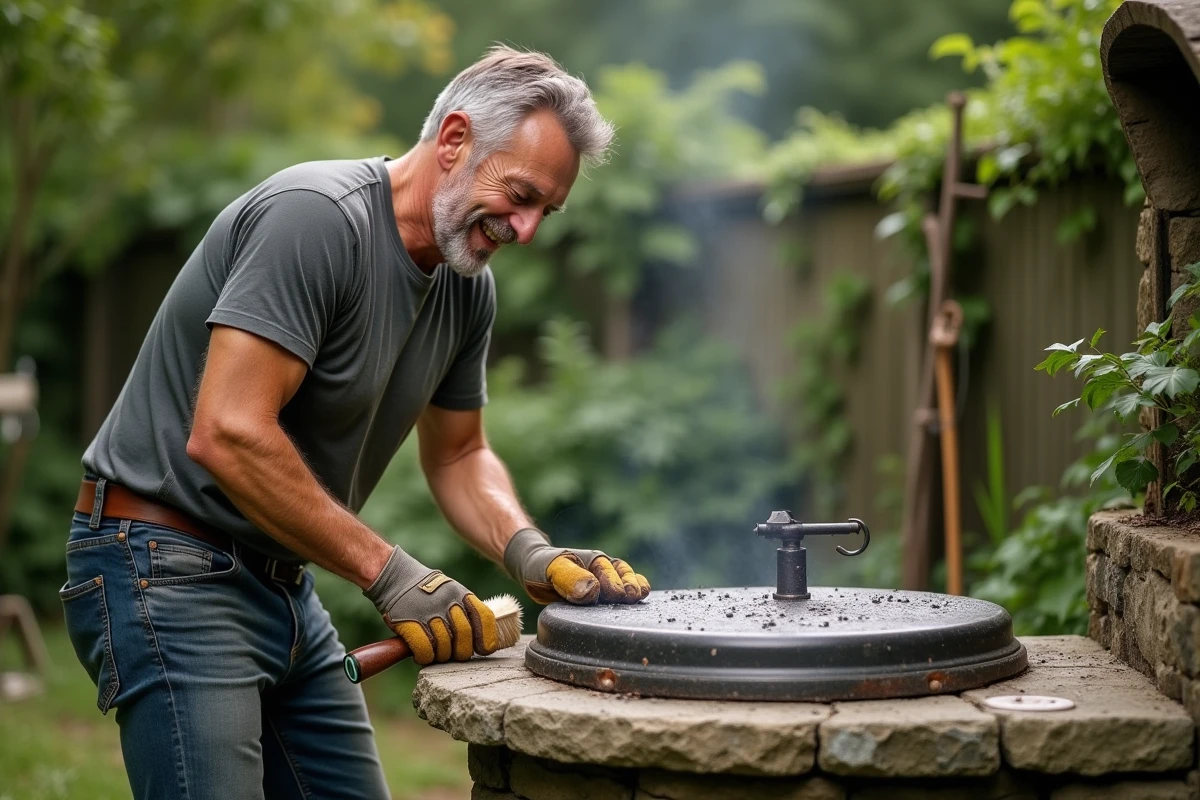
The renovation starts with a good cleaning: carefully remove ashes and cooking residues. To dislodge soot, grease, or moss from the stone, arm yourself with a wire brush, abrasive sponge, or spatula. A simple mixture of white vinegar, baking soda, and water is formidable against stains without damaging the stone. For the joints, prefer a special stone cleaner applied with a squeegee or stiff brush to preserve their integrity while eliminating deposits.
2. Diagnosis of cracks and damage
Inspect every nook: stone, concrete, or refractory bricks of the hearth, nothing should escape your attention. Identify cracks, check the condition of edges and joints. A level will help you control the overall stability of the structure, ensuring safety and longevity.
3. Repairing cracks
For each identified crevice, equip yourself with refractory sealant or silicone adhesive suitable for heat. Apply carefully with a spatula or trowel, without excess. If a joint crumbles too much, replace it with refractory mortar, better suited for high temperatures and the stresses of repeated use.
4. Drying and finishing
To prevent moisture from embedding again, use an air compressor or leaf blower to speed up the drying process. Once the repairs are dry, lightly sand the treated areas with sandpaper to achieve a smooth and pleasant finish.
5. Long-lasting protection
Final step: apply a waterproofing treatment or high-temperature paint on the stone. This enhances the barbecue’s resistance to the elements and limits water infiltration. Regularly check the cooking grill: a little preventive treatment against corrosion extends the lifespan of your equipment.

Recommended products and tips for lasting maintenance
To maintain a stone barbecue over time, it’s best to rely on products that respect the nature of the materials. Waterproof paints or specific high-temperature coatings effectively protect natural or reconstituted stone from the aggressions of moisture and climate. This type of protection limits the formation of moss and prolongs the durability of the hearth, whether the barbecue is exposed on the terrace or in the garden.
The cooking grill also requires special attention. To remove stubborn residues, white or clay stone works wonders. A simple paste made of lemon and salt dislodges grease without risking scratches on steel or cast iron. A bit of dish soap completes the job, especially after large gatherings where cooking has left its marks.
Creating a convivial space around the barbecue also involves thinking about the layout: aromatic plants within reach to scent the air, a wooden table, some seating in rattan or woven fiber, washable cushions for comfort. In the evening, the atmosphere is set with solar lamps, lanterns, or string lights.
On the structural side, stability is non-negotiable. A gravel or stone base, bonded with cement, ensures perfect support. Ready-to-install kit solutions or those made from pallets combine modularity and sturdiness, facilitating installation on any type of outdoor surface.
A well-maintained stone barbecue withstands the seasons without weakening, ready to rekindle the coals for large gatherings or impromptu evenings. Ultimately, a regular maintenance gesture is the promise of rediscovered flavors and memories that are etched in stone, year after year.